
The week started out with a spotty rain shower moving thru parts of our area Monday afternoon followed up by another spotty rain shower Thursday morning in part of our Southern area, and ended with some rain thru most of the area Friday Night into Saturday morning. The rain event on Friday also had some strong winds that took down some tree limbs in spots and also caused some Greensnapping of corn in the Northfield area. In general the week was on the warm side but the moisture was welcomed for pollination that was taking place or soon would take place.
The rainfall also continued a trend which is we will receive measurable rainfall during the week of the Waseca County Fair, which was last week July 15-19. (In the last 40-50 years there is a 70-80% probability we will receive moisture during that time frame.)
Soybean plant development ranges from V4/R1 (Fourth Trifoliate and Beginning Bloom) on some replanted soybeans to R2 (Full Bloom) and I wouldn’t be surprised if some beans were almost R3 (Beginning Pod) at the end of the week on some early planted soybeans.
Planting Date Plant Stage Growth Stage
28-Apr Full Bloom to Beginning Pod R2-R3
03-May Full Bloom R2
10-May Full Bloom R2
01-Jul Fourth Trifoliate/Beginning Bloom V4-R1
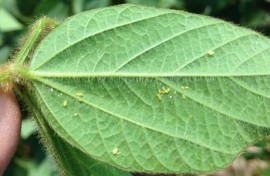
We started to find Soybean Aphid populations increasing slowly except in fields that lack a seed treatment that contained an insecticide package. These “Naked Beans” had 80-120 Aphids per plant where the treated beans Aphid counts were 0-20 Aphids per plant. This fields had the same variety, similar planting date and fertility levels, with the only difference being the lack of seed treatment. In my experience I tend to find Soybean Aphids sooner in fields that:
• The first or last planted soybeans
• By wooded areas that have buckthorn in them
• Soybeans with Seed Treatments with absent or less active insecticidal properties
• Fields with lower Potash (K) levels (140 PPM or less)
I would suspect that we will have some fields hitting a sprayable threshold during the week of July 25th but would hazard to guess we will see the vast majority of soybean fields sprayed during the last week of July and first week of August.
The Septoria Brown Spot we have found in fields is starting to get worse, due mainly to our more moderate temperatures and increased moisture levels, from rain, dews and higher humidity. The concern that comes about with Septoria is that it starts to defoliate the soybean plant from the bottom up. What this fungal disease does is infect a portion of the leaf and much like other diseases it moves and infects the rest of the leaf, which shuts down the photosynthetic capabilities of that leaf. This will move from the bottom of the plant upward from leaf to leaf and plant to plant. By reducing or shutting down the photosynthetic “factories” in the leaves you reduce that total area in the plant that can help fill beans in pods, which reduces yield not only by reducing the number of beans and pods but also reduces the actual size of the soybean seed.
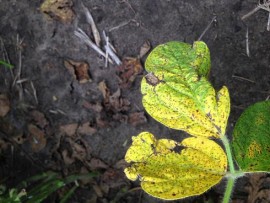
As you are out walking soybean fields’ plants that have Septoria Brown Spot will lose their leaves and will fall to the ground. The photo above shows affected leafs still attached to the petiole but if you look closely to the left of the affected leaves you can see leaves that have already fallen off of the plant.
As soybeans start to flower and enter full bloom (R2) the rapid uptake of potassium (K) and nitrogen (N) is starting. At R2 soybean plants have taken up 15% of that years N and K needs for the year, and by early to mid-August when soybeans plants have reached the beginning seed stage (R5) they will have taken up 70-75% of the N and K needs for the growing season. The implications of not having enough nutrients available to the plant now will become more visible and taking a tissue sample at this stage will help plan for that field’s fertility program in the future.
Soybean plants will flower and put on vegetative growth at the same time. Peak flowering occurs at beginning pod development (R3), with flowering continuing until beginning seed (R5) or shortly thereafter. Not every flower or blossom will produce a pod, in fact it is not unusual for soybean to abort 60-70% of its flowers. The issue with aborted flowers is that it provides and opening for a fungus Sclerotinia sclerotiorum (which causes White Mold) to enter the plant.
White Mold favors cool wet weather conditions in fields with dense canopy’s and high fertility levels. Fields with heavy manure applications or high nitrogen levels are more prone to white mold. Historically fungicides and “burner” type of herbicides have had mixed success in helping to control white mold, with that being said new products have come into the market place that initial data indicates good, to very good control of white mold. If you have had a field with a history of white mold and were going to apply some method of control now would be the time to do so.
Corn plant development ranges from V16 (collar on Sixteenth Leaf) to R2 (Silking and or Early Blister).
Planting Date GDU’S Plant Stage Growth Stage
15-Apr 1324.5 Silking/Early Blister R1-R2
23-Apr 1276.5 Tassel/Silking V18-R1
30-Apr 1242.5 Tassel/Silking V18-R1
08-May 1145 Collar on Sixteenth Leaf V16
We accumulated 176 Growing Degree Units (GDU’s) during the week which averages out to 25.14 GDU’s per day. This is 26 GDU’s more per week or 3.71 more GDU’s per day.
Dates 2015 GDU/Day 30 Year GDU Average/Day Difference/Day
July 12-18 25.14 21.43 3.71
July 1-18 20.00 21.00 -1.00
Dates 2015 GDU/Week 30 Year GDU Average Difference
July 12-18 176 150 26
July 1-18 360 378 -18
On an average year mid pollination for most hybrids in our area will be 1250 GDU’s with the latest mid pollination at 1340 GDU’s on a 111 day hybrid and the earliest would be 1202 GDU’s on a 92 day hybrid.
The 30 year average in Southern Minnesota for tassels dates or mid pollination of 1250 GDU’s is July 19. Comparing Central Valley data for tassel dates from 2007 to 2014 our average tassel date is July 19 with the earliest mid pollination being July 7 in 2007, and the latest mid pollination being July 30 in 2013. (If you took out the years 2013 and 2014 the average tassel date would be closer to July 16). The way things are shaping up I wouldn’t be surprised if our average tassels dates would be July 19-20.
Average Tassel Date Year
07-Jul 2007
23-Jul 2008
27-Jul 2009
12-Jul 2010
21-Jul 2011
08-Jul 2012
30-Jul 2013
24-Jul 2014
Receiving moisture just prior to and during pollination increases the probabilities of having a successful pollination period. Water usage varies by hybrid and genetic family but on average a corn plant will utilize 3-5000 gallons of water per bushel. So in a 200 bushel corn crop you would need 600,000 to 1,000,000 gallons of water. In a typical 1 inch rainfall there is 27,154+/- gallons of water per acre and if you multiple that out over a section or 1 square mile that is 17.4 million +/- gallons of water.
In looking at the physical structure of a corn plant the leaves of a corn plant act like a funnel (the portion of the leaf that bends toward the stalk) in that any moisture will roll down the leaf and stalk and into the root system. This structure makes that corn plant more efficient with the water it receives whether it is a heavy dew, a light mist or a rain.
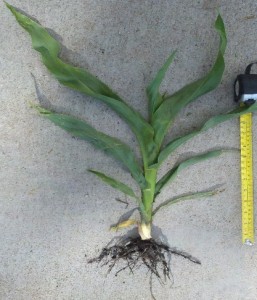
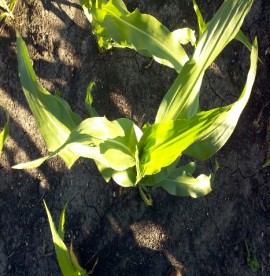
One of the topics that has come up in the last few years has been higher nighttime temperatures during the grain fill time. The old adage tale is that warm nights makes the corn grow faster, that may be true in the vegetative growth stages (V1-V18) but once you start the reproductive stage silking (R1) to dent (R5) you want that corn plant to cool down at night. When nighttime temperatures do not fall below 72° F the corn plant does not slow down and keeps on metabolizing sugars at a high rate. This high rate of nighttime metabolism is termed ‘dark respiration’ which cause those plants to fill kernels reducing the grain fill time and makes the plant mature quicker. Yield losses of 2 to 3.6 bushel per acre have been documented for every 1° F increase over 72° F during the nighttime hours.
We are continuing to see higher levels of Eyespot occurring as well as some early stages of Northern Corn Leaf Blight (NCLB) starting to show up. It is my opinion that at this point the fields that had a V4-V8 application of Fungicide applied have lower instances of both Eyespot as well as NCLB. With the hot humid weather conditions that we have had and are predicted we may see NCLB as well as Eyespot reach levels that would indicate a fungicide application even on fields that have already received an earlier V4-V8 fungicide application
Upcoming Events:
• Rice County Fair July 21-26
• Central Advantage Plot Blooming Prairie July 22-23rd **Date Change***
• Farmfest August 4-6 Gilfillan Estate, Redwood County
Social Media: Find us on Facebook https://www.facebook.com/pages/Central-Valley-Cooperative/1417488761867155 and also on Twitter at https://twitter.com/CvCoop1. If you are having problems with the links, please see the www.centralvalleycoop.com homepage to like us on Facebook or follow us on twitter.
Central Valley Website: Past Central Valley Agronomy Notes and Agronomy Topics of the week can be found on our website www.centralvalleycoop.com under the Agronomy page.
If you have been receiving our Agronomy Notes or Agronomic Topics of the week via mail and now have an email address and want them emailed to you, contact your local Central Valley Agronomist or myself at [email protected] and we will get you on the list. Use the same procedure if you would like to be taken off this mailing.
