Uncategorized News

Agronomy Update April 15, 2015

Soil Temperatures at 8:30AM were 44°F at the 6” depth and 45°F at the 2” depth

Just a few quick reminders on planting.

· Allow fields to dry after working ground, work a field today, plant it tomorrow

· Planting Depth 1.75 to 2 inches deep, add .25inch to allow for soil to compress

· Find the sweet spot for planter speed, a Goldie Locks speed, not too fast, not to slow

· Use Ascend or products that help emergence, it does make a difference in emergence
 

Nutrient Uptake by Modern Hybrids by Brian Weller

As Agronomists we have know that certain hybrids or genetic types have shown greater response to increased rates of Nitrogen (N) or split applications of Nitrogen than others.

Recent Data from Purdue has shown that today’s hybrids take up to 27% more total Nitrogen after tasseling than pre 1990 hybrids. At first thought it makes sense that as you increase yield, which has taken place since 1990 nutrient uptake will increase as well. What this study points out is that the uptake is taking place later in the growing season.

Managing nutrient uptake later in the season especially Nitrogen is easier than it has been in the past. We can’t kid ourselves, we are still at the mercy of the weather and putting a solid base rate of Nitrogen on early is still a good plan. We now have more options for applying Nitrogen products than we have in the past.

  • Sidedressing with UAN (28% or 32%) or Anhydrous Ammonia (Nh3) is still a good way to put N on. (And in the case of UAN products we also have a the opportunity to put additional Potassium (K) or Sulfur (S) on.)
  • Topdressing with Urea or Coated Slow Release Urea with a High Clearance Spreader into a standing corn.
  • Drops or Drop Tubing UAN products onto the soil surface after canopy
  • Aerial applying or combing Slow Release Nitrogen products with your Fungicide prior to Brown Silk.

Read more …

Tips on taking Soil Temperatures

Grain Bin Rescue Training

Central Valley/Interstate Mills provided Grain Bin Rescue Training for their employees and the first responders that service our communities.

“We value our partnership with local rescue teams for the service they provide to our business and our patrons and felt that we wanted to open these sessions up for all of those who would like to attend”stated Dave Picha, Safety Manager at Central Valley/Interstate Mills.

With the plentiful harvest we observed in our area last fall, we find ourselves looking at the potential for individuals to get themselves in trouble transferring grain on and off the farm. In an effort to keep our employees trained in the event of an entrapment or incident with grain, we worked with the Safety and Security Consultation Specialists of Southern MN, who brought in a grain entrapment simulator to demonstrate how fast an entrapment can happen and the importance of a well-executed plan. A plan is vital in ensuring a positive outcome in these situations. They spoke about tools needed and making a list of those who could help if a situation arose, also everyone in attendance had an opportunity to be on a team that recused one of their members from the simulator.

This is the type of training you hope to never have to use, but in our communities this is very real so please enter every bin with caution and the understanding that things can happen very fast, never take a chance and always let someone know your plans.


Central Advantage Team holds Annual Meeting

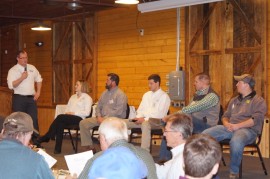
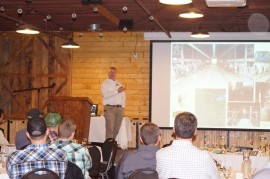
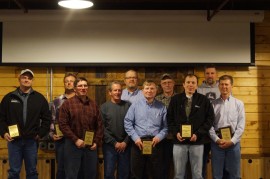
Our Central Advantage team held their annual mtg on Jan 15th. Growers that have utilized the Central Advantage program for 10 years were recognized and presented with a plaques from their CA team member. Presentations were provided by Kevin Kruize, Central Advantage Manager, Kate Stenzel, CA Sales Agronomist, Larry Stoller, Affiliate & Industry Relations Manager at U.S. Farmers & Ranchers Alliance. Johnathan Zuk, Region Agronomist and also a Panel of guests from IL and IA, shared their insights on precision agriculture.

DSC02787

DSC02880

DSC02902

DSC02910


holiday2

christmas photo1

Hail hits area this past weekend

Attached is a Hail Assessment Bulletin that one of our suppliers put together that does a nice job of outlining yield lose by growth stages in both corn and soybeans.

2014 Late Season Hail Assessment TB

Because of the timing of the wind and hail we may see considerable yield loss. Contacting your insurance agent and speeding up work on harvest equipment to get it ready to go will become crucial.

On Soybeans that received hail damage we will start to see the “Snap, Crackle, Pop” effect. Soybean pods that were hit by hail stones will start to dry, the damaged pod will “Snap” open, the pod will start to “Crackle” and with wind moving the pod the soybean seed will “Pop” out of the pod. Bruised stems on soybean plants may cause more lodging and will be more prone to wind damage.


Beans that were previously hit by frost last weekend may have already started the “Snap, Crackle, Pop” effect.

On Corn that received hail damage the odds of having mold start on affected ears increases dramatically.



It’s a Good Time to Fill your Tanks! by Steve Johnson, Energy Division Manager

Gasoline and diesel prices are lower than they have been in a long time. Now is a good time to fill tanks for fall usage as long as you will be using the diesel by the first of November. The reason I say this is because all diesel we sell is mandated to contain B10 or 10% biodiesel until the end of September. Diesel sold during the colder winter months is mandated at 5% diesel. It would be a good idea to use the B10 fuel in your tanks before the colder months because the cold flow properties of B10 are worse than the B5. Read more …

Agronomy Notes for the Week Ending August 16, 2014

We received some spotty rainfall early in the week with some heavy dews most mornings. These heavy dews and spotty showers are keeping plants alive and helping to put yield on, remember now is when rain makes grain, especially soybeans.

We did have some wheat that was harvested in the area during the week which seemed “normal” in that it seemed that wheat is combined during the Steele County Fair time frame.

Corn plant development ranges early late Blister (R2) and early Milk (R3) to early Dough (R4). The cooler nights and heavy early morning dews have been favorable for kernel development and starch accumulation.

Planting Date GDU’S Plant Stage Growth Stage
25-Apr 1778 Early Dough R4
05-May 1758 Late Milk to Early Dough R3-R4
11-May 1710 Milk R3
17-May 1676 Milk R3
24-May 1618 Late Blister to Milk R2-R3

Read more …

All news posts »